Hands That Read: The Book Body as Interface in Interactive Picture Books (2010–2025).
A theoretical framework for material and hybrid meaning-making in post-digital children’s literacy
DOI:
https://doi.org/10.57579/2026.8Keywords:
Epistemic objects, interactive picture books , multimodal literacyAbstract
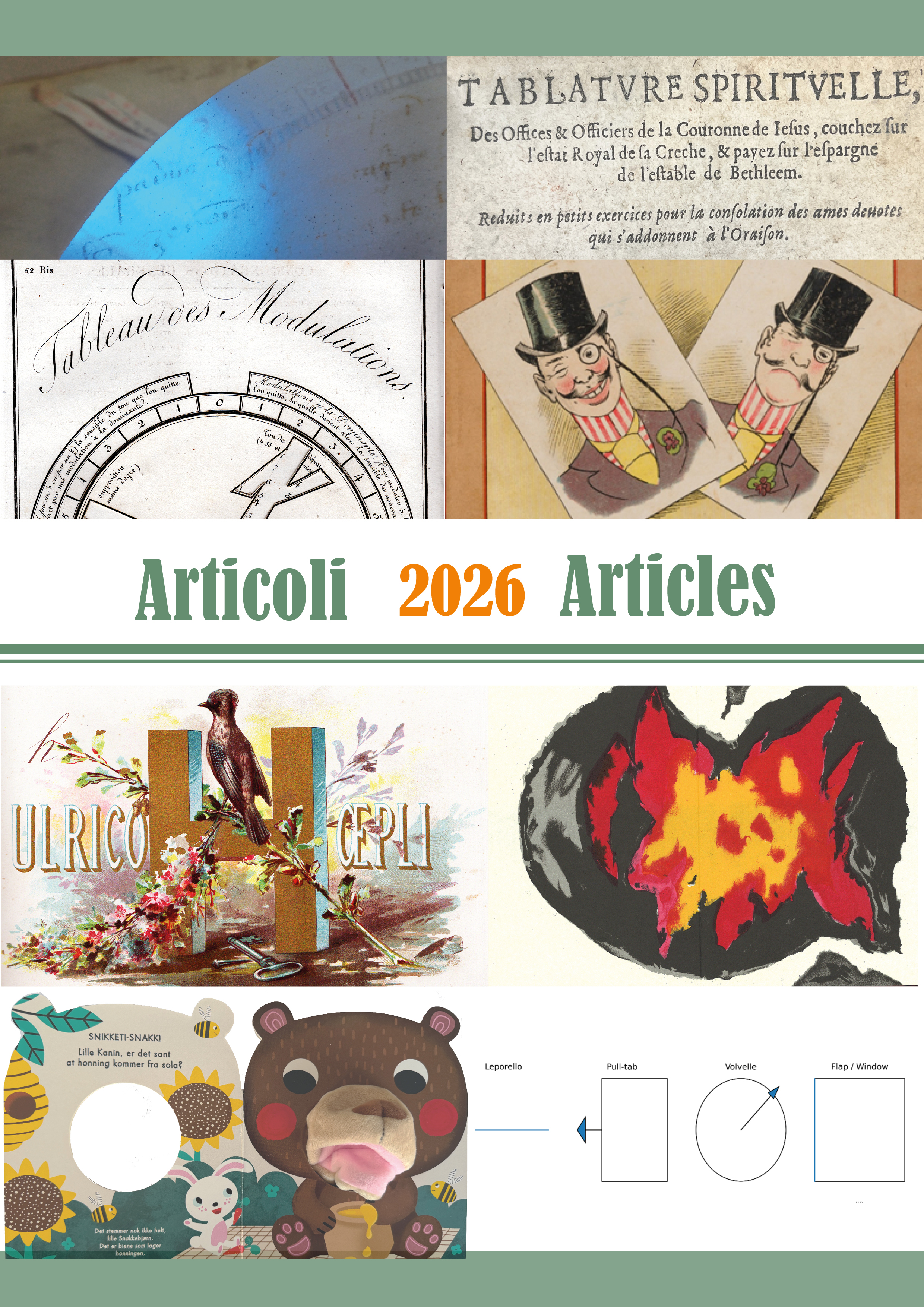
This article offers a theoretical account of interactive picture books as epistemic objects, proposing the book body as interface that stages meaning through material and hybrid operations. Spanning 2010–2025, from engineered print to page-registered AR, we synthesize visual-culture, multimodality, and material engagement theory to show how flaps, windows, pull-tabs, volvelles, leporello, transparencies, and AR overlays implement a mechanics of discovery (cue - action - reveal - re-framing). We formalize three construct manipulations as evidence, attentional traction, and retroactive contextualization - explaining how gestures externalize inference, steer attention, and license reinterpretation. Methodologically, we specify micro-analytic interaction scripts and propose interaction maps (states × actions) to model exploration topologies without empirical datasets. Our core contribution is a typology mapping mechanism ? information operation ? cognitive function, clarifying why multi-step, consequence-bearing interactions support spatial reasoning, causal rehearsal, classification, and language development, whereas surface busyness risks extraneous load. We theorize print - AR “hybrid bridges”: AR acts as a registered lens that models hidden processes and scales while preserving reference to the page. Accessibility and ethics are constitutive - redundant multimodal cues, inclusive imagery, privacy-by-design, and sustainable, page-complete pathways - summarized by three maxims: constrain to enable, cue before you ask, and augment, never gate. The framework offers design-to-cognition principles and a transferable vocabulary that subsequent studies can operationalize across developmental stages and cultural editions, aligning aesthetics, cognition, and ethics in post-digital picture book literacy.
Downloads
Published
Issue
Section
License
Copyright (c) 2026 Milan Mašát

This work is licensed under a Creative Commons Attribution 4.0 International License.
JIB is an open access journal that applies a "Creative Commons - Attribuzione" (CC-BY) license to all published material.
With the CC-BY license, authors retain the copyright on their contributions, while granting anyone the possibility to download, reuse, reprint, modify, distribute and/or copy the materials published by JIB, with the sole condition that the author and the title of the magazine are correctly cited. It is not necessary to request further permission from the author or the editorial staff of the journal.